

The views expressed here are my own, and do not necessarily reflect official positions of Helena.
Here’s a question I’ve posed for years: should we retract old scientific papers?
Look, here’s me posing it seven years ago.
It’s become a more interesting question since. We increasingly invent more powerful tools for assessing published scientific accuracy, and far more powerful tools for hoovering up and structuring the data that’s been locked into them.
Given that, it’s reasonable to expect that the near future will contain new observations about old data. Some of it will be bad. Some will be sufficiently egregious that we will ask the question — should we kill this paper?
My opinion hasn’t changed much in seven years, and it is this:
1. Is the old paper still in use as a citable object? The publication date notwithstanding, is the paper still functioning in live scientific discourse? If we’re citing it now, it’s a ‘current document’. I care much more about this than the date the paper was printed. If it’s never cited, it’s much harder to care.
2. Author profile matters. Status and reputation shape whether anything happens to a paper, not matter when it was published. It should be otherwise, but it isn’t.
3. Obviously, the nature and extent of the problem. How serious the defects in a paper of interest are, which range between tiny mistake and glowing neon sign saying FABRICATED — and, then, how much other work it contaminates.
Basically, I don’t believe in “is it too old?” and I do believe in “is it still load-bearing?”
I also believe that the obstacle to retraction is overwhelmingly institutional unwillingness rather than genuine uncertainty around whether or not there’s a problem. I understand this, people have their own shit to care about, which I resent bitterly as they should be prioritizing the things that I think are important instead.
That being outlined, let’s make a timeline.
Williams, Kroes, and Munro (2000) publish a paper on glyphosate safety. Glyphosate is a herbicide. The paper says, more or less, ‘yes, it’s safe’. Let’s call this WKM2000.
(Note: I have no considered position on glyphosate, so I’ll do you a deal: you get to believe whatever you like about it, and you accept that I don’t have the bandwidth to care about this chemical because the amount of data available is astronomical, the issues around ‘safety’ (a very broad and dumb term in isolation anyway) are complicated, and it genuinely does require localized expertise to understand it well. *IF* all the subsequent literature can be believed, it sounds about as volatile as self-raising flour. But I really don’t know. I’m not the Renaissance, I don’t know everything, and this is one of those things. If that isn’t enough for you because you’re hoping for a bold declaration on my part, then, live with it.)
circa 15th March 2017 — NPR gets into the Monsanto papers, and finds evidence of ghostwriting in a key glyphosate paper:
Internal company emails, released as part of a lawsuit against the company, show how Monsanto recruited outside scientists to co-author reports defending the safety of glyphosate, sold under the brand name Roundup. Monsanto executive William Heydens proposed that the company “ghost-write” one paper. In an email, Heydens wrote that “we would be keeping the cost down by us doing the writing and they would just edit & sign their names so to speak.” Heydens wrote that this is how Monsanto had “handled” an earlier paper on glyphosate’s safety.
That earlier paper, published in 2000, acknowledges Monsanto’s help in assembling the data, but does not list any Monsanto employees as co-authors.
You can probably guess what ‘that earlier paper’ is! Yep, it’s WKM2000.
23rd March, 2017 — New York Medical College reviews the problem (because the ‘Williams’ in WKM2000 is a pathologist at NYMC, and announces that there isn’t a problem. Eight whole days between dates, less internally. How suspiciously speedy. Almost as if they didn’t care.
17 July, 2025 — Kaurov and Oreskes publish a paper about this episode in Environmental Science & Policy. Pretty interesting premise, and it’s directly reflective of my introduction above.
To summarize: ghostwriting is research misconduct, because misrepresenting who writes a paper misrepresents what a paper is. The point isn’t ‘outsourcing is naughty’, when it’s done with a declaration we just call that ‘adding more authors’. However, ‘concealing the party with the financial stake in the conclusion and borrowing someone else’s credibility’ is naughty.
K&O weren’t interested in ghostwriting, they were interested in the life and reputation of the paper subsequent to the frank and straightforward admission of ghostwriting. From their Discussion:
WKM2000 had a strong presence in policy discussions and regulatory decision-making. Of 36 policy documents analyzed, only seven acknowledged its ghost-written nature or potential conflicts of interest. The majority cited WKM2000 uncritically to support claims about glyphosate’s safety, suggesting that regulatory bodies may lack adequate mechanisms to identify or respond to ghost-written research. Policy frameworks often rely on papers that have gained prominence through high citation counts, presuming their academic credibility. As WKM2000 ranks among the most cited papers in glyphosate literature, its influence cascades into regulatory decision-making. The inclusion of ghost-written papers like WKM2000 illustrates how corporate interests can exploit these mechanisms to their advantage.
That certainly meets my ‘load-bearing citation’ definition. And clearly the journal that published WKM2000 agrees, because…
December, 2025 — WKM2000 is retracted.
After this, 66 toxicologists put their heads together to come up with a trenchant complaint about how this was handled, and object in the strongest possible terms to the whole sorry episode.
This post is about the paper that they wrote in service of that objection.
If you’ve been skimming this so far, this is where the fun part starts.
If you want blood, you got it.
Borgert et al. (2026)
(^ You should probably read the paper first. It’s not very long and it’s open access.)
H. L. Mencken said this about the writing of President Warren Harding:
“It is so bad that a sort of grandeur creeps into it.”
This is that, but in a commentary paper.
It might be the single least effect piece of advocacy I’ve ever seen, sufficient that I’ve finally gotten around to dealing with it months after it limped into publication. It’s been there in the back of my mind, a Lego in the dark waiting to be stepped on.
Every time I looked at it, it somehow became worse, less credible, more outlandish. Point after point, issue after issue. My suspicions around its quality became confusion, which became incredulity. Am I missing something? Am I being unreasonable?
I have to do this block by block, I’m afraid. There’s a lot to get through. I’ll bold the relevant sections.
OK. First bit first:
As authors, editors, peer-reviewers, and members of the editorial boards of prominent journals in various scientific fields, including the field of toxicology and the journal RTP, we believe that the retraction of the Williams et al. (2000) review is both unjustified and indefensible. The decision was not grounded in any scientific error or fraud in the retracted article but appears to reflect a subjective ideological perspective that failed to consider and account for all the facts. This solo editorial decision sets a dangerous precedent in which historical, well-received papers are withdrawn on alleged procedural technicalities long after the standards by which they were originally accepted may have changed. Indeed, the COPE guidelines were first published in 1999 and have undergone significant revisions in 2004, 2007, 2011, and 2017, (COPE, accessed 2//20/2026). Moreover, long-delayed retractions like this(25 years afterthe original publication) are likely to find the authors retired or no longer alive and thus in no position to defend themselves or the data they had published. Instead, the proper answer to any editorial qualms about this paper would have been to seek substantive, refereed scientific rebuttals rather than to issue a retraction with no objective evidence to justify such an action (Siddique et al., 2024).
This was the original issue that caught my eye.
This is not a bad point in isolation: contemporary standards do change, and it becomes quite tricky to understand how we should respond to old papers written under different standards.
However, this point is exceptionally poorly made here.
Let’s start with ‘alleged procedural technicalities’. Here’s what actually happened, the actual internal Monsanto communication from the Monsanto Papers which are directly quoted in Kaurov and Oreskes:
A less expensive/more palatable approach might be to involve experts only for the areas of contention, epidemiology and possibly MOA (depending on what comes out of the IARC meeting), and we ghost-write the Exposure Tox & Genetox sections. An option would be to add Greim and Kier or Kirkland to have their names on the publication, but we would be keeping the cost down by us doing the writing and they would just edit & sign their names so to speak. Recall that is how we handled Williams Kroes & Munro, 2000.
The author of this text is a man named William Heydens, and he’s doing something every manager in every office loves doing — a bit of costing. Ghost-writing is a line item here that needs management, and it’s cheaper than the alternatives which involve actually hiring scientists. “Keeping the cost down by us doing the writing”? The names are a purchase. “They would just edit & sign their names so to speak” — so to speak? It even has the little verbal ‘eww’ of someone who knows what he’s describing.
And then the crown jewel: “recall that is how we handled Williams Kroes & Munro, 2000.” This isn’t some admission under pressure from an angry Tom Cruise in a courtroom, it’s a precedent in a freaking planning document, shown to colleagues who would recognize what it means.
Does that sound like a procedural technicality to you? Oh man.
But even if it was. Let’s deal with the next bit: “alleged procedural technicality long after the standards by which they were originally accepted may have changed”.
Why ‘may’ have changed? That leaves the door open, and the reader is invited to think that maybe the old research integrity standards didn’t really cover This Sort Of Thing, that it is a contemporary problem we’ve retrofit onto ‘an earlier time’. Psychologists were notorious for this a few years ago — ‘what do you mean we p-hacked and HARKed this study halfways to death in order to get it published? that was just how we did things Back In The Day! you can’t call it dishonest tripe now! that’s meaaaaan!’
The only massive problem with that argument here is: the 1999 COPE Guidelines, the contemporary research integrity standard available when this paper was published, explicitly mentions this situation, and so has every COPE guideline since.

Let’s make that sentence actually honest.
Indeed, the COPE guidelines were first published in 1999 and have undergone significant revisions in 2004, 2007, 2011, and 2017, (COPE, accessed 2//20/2026) — and every single bastard one of them explicitly mentions, warns against, and includes potential sanctions for ghostwriting, so our previous point is moooot, a longer moot used when an issue is very moot.
Look, I don’t like COPE. I’m sure it would be mutual if they’d heard of me, which they haven’t, and if they had, it wouldn’t matter because they have all the statutory authority of a child dressed as a policeman for Halloween.
But COPE do actually make serious and carefully considered recommendations, have done since their inception, and there was never any chance that they just happened to forget that corporate ghostwriting was a thing, even in the year 1999.
That covers the first issue that I saw.
At this point, I started to get really interested, and that’s when I become more detail-oriented and boring, so buckle up.
The central argument
Borgert et al.’s test for ‘is a paper retractable’ is ‘was the science wrong?’, which they claim the paper passes, because of all the glyphosate safety literature that’s been published in the intervening 25 years.
This is, and I really am trying to be nicer as I age, daft.
The test being applied — CORRECTLY — by the journal is clearly “is the paper what it claims to be?” which it fails utterly because look at the actual quote that was conveniently never included. It is a willing suspension of disbelief to look at what the text actually said and conclude this was an obscure procedural error. Borgert and pals didn’t even have the honesty to include the quote itself amongst 2k words of other stuff. What a convenient omission.
In the absence of an actual invoice to an external expert that lists “putting your name on a paper we wrote for you, x1”, admissions of ghostwriting don’t get any more bald and straightforward than they do in this case.
The best argument is the worst argument
“In this instance, these independent assessments of glyphosate’s safety by multiple expert panels and agencies around the globe affirm the conclusions of the retracted Williams et al. (2000) article, and the retraction is irrelevant to their conclusions (Moretto and Boobis, 2026).”
In this section, the authors are claiming that since this paper was a while ago and evidence has accrued so much in the meantime, that the retraction doesn’t change the modern regulatory conclusions around the same topic…
Erm, good?
If the retraction is irrelevant to the regulatory conclusions, then retracting costs the regulatory record absolutely nothing, and we aren’t conflating the whole aggregated scientific position with the status of a paper written while I was in high school that misrepresented its own authorship.
I genuinely struggled with this point. In the middle of claiming that it was an outrageous injustice that this paper was retracted, the authors freely admit that it doesn’t change the center of the important outcome it might affect.
So what’s all the fuss about?
The great investigation that wasn’t
Dr. van den Berg failed to disclose that the New York Medical College previously investigated allegations of ghostwriting for the Williams et al. (2000[29]) paper and found no support for those claims (Cornwall, 2017[4]).
This is my favorite bit.
NYMC only learned of the documents that started all this mess when a reporter from called them… about the 22nd March. They announced a finding on 23rd March.
I said eight days before. That’s the timeline of the articles. The internal time for considering the actual problem was one day. Ish.
Nobody reviews some abstract authorship arrangement / COI issue in a day. That isn’t an interview, retrieving a document, looking at a draft, or calling Monsanto on the electric telephone.
Here’s that investigation:
“Oi Barry, did you do anything wrong?”
“… nah”
“Good enough for me, let’s tell the press.””
Of course, NYMC said it does not disclose details of internal investigations (like whether or not any exist, for instance) and considers the matter closed.
That isn’t a process, it’s the absence of a process, and it’s exactly the same wagon-circling nothing-to-see-here investigative fiction that normally takes nine months to produce the same result. Kudos to NYMC for having the honesty to just cut to the exoneration immediately and saving their staff the time pretending this mattered to them.
I’m being glib, so: a real inquiry means a formal misconduct process, maybe lawyers, a tenured senior figure under investigation (which will leak), a nine-month timeline if you’re quick, and a written finding that becomes discoverable in any potential litigation against a company with unlimited legal resources.
Institutions are not and have never been neutral arbiters of their own faculty, they haven’t started since this incident occurred, and they won’t start any time soon. They have the most to lose, and have to pay money and endure arseache to investigate themselves.
Presenting ‘we-decline-to-investigate-because-there-isn’t-a-problem’ as some kind of exoneration is a hilarious distortion.
The final silliness…
“With the strongest conviction, we assert that retracting a paper without scientific flaws isn't protection-it is censorship.”
With the strongest conviction, I assert that we retracts lots of papers, all the time, for issues that have nothing whatsoever to do with ‘scientific flaws’.
With equally strong conviction, I can list many of the reasons off the top of my head, because there are many, and might even represent A MAJORITY OF RETRACTIONS.
Authorship misrepresentation a.k.a. ghost, guest and gift authorship. Hi!
Undisclosed conflicts of interest. Hi again.
No ethical approval for human or animal work. Witness the titanic meltdown of Didier Raoult, literally happening right now.
Missing or withdrawn informed consent.
Publication without the knowledge or permission of a co-author, or of the data’s owner. This is a big one!
Duplicate and redundant publication. The science being ‘without flaws’ twice is the problem.
Plagiarism. Sometimes text recycling. Correct claims, pilfered words.
Paper mills. The most interesting one right now, as we see the rise of the Potentially Correct Paper Mill Paper.
Authorship-for-sale. Not necessarily in a paper mill, separate scenario where slots are sold privately. Hard to detect, definitely happens.
Compromised peer review. Fake reviewers a.k.a. a peer review ring. Process problem, not content problem. Probably responsible for most of the largest single-incident retractions from not-actually-the-science. We assume these papers are bad, but we don’t check — there’s no need.
Legal reasons. Defamation, court order, privacy, data-protection breach, blah.
Copyright violation. Duh.
Sanctions or export-control breaches. Material obtained unlawfully! Rare but significant when it happens.
Rigged citation arrangements a.k.a. citation rings. Easy to spot, hard to motivate journals.
Are there others? Probably. This is just all the common ones. Most or maybe even all of these are invoked in the many COPE Guidelines the authors clearly didn’t read.
And in a rare double whammy of silliness, we invoke censorship.
Everyone loves to complain about censorship. The word sounds good said out loud.
Retractions are not censorship, the suppression of content. Retractions are a content label. The bastard thing is still there, perfectly readable, with a big red mark on it. If retraction meant censorship, it would make whole sleeves of metascience impossible! We would be trying to back-channel and retrieve retracted papers from someone who just happened to maintain a copy instead of just downloading them wholesale! This editorial accusing publishers of censorship is itself an open access, indexed, DOI’d, free to read, republished-with-a-corrigendum document.
Oh, and there’s a follow-up editorial in a second journal.
Everyone involved said everything they wanted to say, with maximum volume. When they were denied the opportunity to publish their original correspondence, as if somehow the first journal owed them a publication slot just because they brought all their friends, they howled.
Have you considered that RTP didn’t publish your article because it isn’t very good?
… and when I got mean
Having skimmed through the above, I was ready to let this slide without writing anything. I have two working principles that apply here:
(1) Stooges gonna stooge, and
(2) People make silly arguments all the time about scientific integrity — primarily because a lot of researchers, even fairly senior researchers, only encounter it as a topic they have to engage with when something goes wrong and they’re also upset.
(2) is the main reason, really. The whole donny that can arise around research integrity / publication / regulation / statistics is usually some big mess that researchers who’ve never thought about the thorny issues here are accidentally forced into one unfortunate day. Their unfamiliarity with the mechanics and their emotionality shines brightly when they commit their objections to the public record.
So I read most of this paper thinking I was emotionally capable of letting this go without comment because of that reason. Then I changed my mind.
I feel there is a difference between how I respond to arguments (even if they are nonsensical, obfuscated, mushy arguments — see above) vs. how I respond to people being petty.
I don’t want people to push my petty button, but they just had to go and do this:
“Neither Kaurov nor Oreskes has expertise in toxicology or cancer biology.”
This is cheap, and rude.
Kaurov and Oreskes make no toxicological claims. Their paper is about authorship, provenance, and citation behaviour: who wrote a document, how it got propagated every which way into policy documents, and whether the works that cite this paper acknowledge its origins now we know it was ghostwritten.
Oreskes in particular is a professor of the history of science at Harvard whose scholarly career is exactly this: how industries manufacture scientific-looking doubt through funded researchers and literature strategies. She literally co-wrote the canonical popular work on this topic fifteen years ago.
Demanding toxicology credentials for a paper about authorship is point-scoring, line filler, high-school debate crap.
Imagine being an auditor at Bayer and being told your financial reconciliation of someone’s shit record keeping around lab chemicals was incorrect because you weren’t a chemist.
The citation on this document is a mess
In the original document, “Mozart M (2025)” is cited three times in the body, on pages 1111, 1112 and 1113, and listed as a Retraction Watch article.

RW articles carry bylines, and this one says Ellie Kincaid, who is an excellent staff journalist at RW. It does not say Mozart, because this isn’t 18th Century Vienna.
What the RW article does have, though, is a a photograph of a Roundup bottle credited to “Credit: Mike Mozart/Flickr (CC BY 2.0)”.
These muffins cited the stock photographer as the author.
Three times.
And yes, they issued a corrigendum to correct this, but instead of correcting it (“Kincaid E” would be traditional, appropriate, and respectful, for instance), they just took the reference out.
Now, I can’t prove that this sloppiness is due to the paper being AI-assembled. So I’m not at all sure that’s the case. But it is actually the most favorable explanation to the authors, because if it’s daft misunderstanding vs. letting some language model make parsing failures that you never checked, I’d rather have people think I was lazy rather than didn’t read things I was citing sufficiently to understand their authorship.
(Note: the paper does have a disclosure that AI was used “to augment searching of standard scientific databases”. Possible it did more than that. Plausible? You tell me.)
Having established there might be a little problem here, I set my own language model to the task of figuring out if there were any other citations that might be a little… odd.
And, unlike them, I check the work of agents. Which is why I am proud to present to you Uncle Claude’s contribution to this document:
“Berry SC” in the Williams et al. 2016 reference — the honorific “Sir” parsed as a given name, producing initials that aren’t his; he is Colin Berry, indexed as “Berry C” in the companion paper in the same supplement and in Taylor & Francis’s own notices
“SCB” in the competing-interests key — the same honorific-as-forename error propagated into the editorial’s own disclosure, so decoding the initials requires treating “Sir” as a name
Greim DOI printed with a space inside it —
10.3109/104 08444.2014.1003423, dead as printedEXCLI URL printed with a space —
https://www. excli.de/excli/about, but URL works“Mon-santo” — a PDF line-break artifact copied verbatim into the Malkan reference title
COPE retraction guidelines dated 2025 in the reference, with a DOI resolving to the 2019 version (
cope.2019.1.4)“(COPE, accessed 2//20/2026)” — doubled slash in the in-text date
COPE Chapter 11 citation with a closing parenthesis and no opening one — “topics 11.2, 11.4, and 11.5 COPE, 2011)”
“Modern AG Alliance” in the reference list against “Modern Ag Alliance” in the body
“EFSA (European Food Safety Authority) et al. (2017)” and the same for 2023 — an agency given co-authors
U.S. EPA 2016a has no URL or DOI at all — the only entry in the list without a locator
U.S. EPA 2016a dated 2016 but internally dated 2015, with “(2015; finalized 2015/updated reviews)” standing in for a date
U.S. EPA 2016c labelled 2016 but internally dated 2017, carrying an embedded quote and a parenthetical instruction to consult a docket
ECHA 2022b cited as “~151-page document with detailed toxicology/carcinogenicity review” — a description of a document, not a citation
ECHA 2017b cited as “Available via ECHA Registry of CLH intentions:” — a search result, not a citation
FAO/WHO 2016 cited as “Summary report available; full evaluations in the volume (e.g., …)” — likewise
Williams et al. 2025 given as a raw PubMed ahead-of-print string — “Regul Toxicol Pharmacol. 2025 Dec 4: 106006”
Body cites “[EXCLI, 2026]” against a list entry reading “EXCLI (accessed February 20, 2026)”; same mismatch for Sullivan Papain
Three citation styles in one list — abbreviated Vancouver, full-title APA with commas, and the pasted PubMed string
This makes it harder, not easier, to determine the provenance of this document. I think a good model, correctly prompted, would not make such a mess. Mine (Fable 5.1 in this case) did a good job at finding it all. Models won’t write anything for you that’s worth a damn, but they can be really good at copy editing.
But if some distinctly-less-good model was left to its own devices and its output had no human oversight… who knows? Suffice to say, it’s pretty funny to complain about publication standards when you and 65 of your best friends haven’t mastered referencing and citation.
The mystery of the non-publication at RTP
“It was withdrawn because co-Editor-in-Chief Dr. van den Berg would only accept a truncated version that neither transparently listed all authors nor permitted a full exposition of his retraction decision.”
If we’re going to Do The Details, this leaps out at you, because it actually has checkable numbers in it.
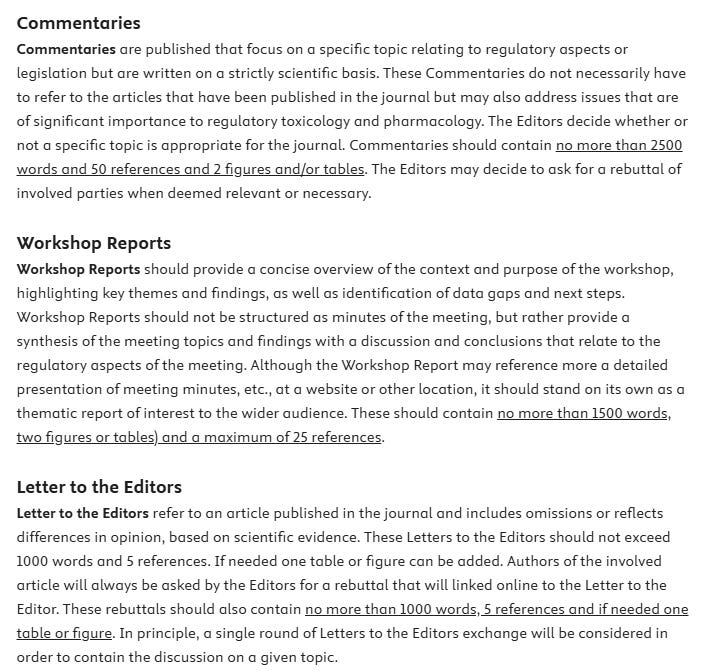
I’ve cut that section of the RTP conditions of publication out, because it includes both the formats this sad missive would typically inhabit.
There’s about ~2000 words of text here (and ~1200 words of authors!) So it would absolutely fit within a Commentary, easily. However, what seems more likely is that this is just a long Letter. Moaning about a ‘difference of opinion’ (see above!) is the classic reason for writing a letter.
In other words, the journal was always entirely within its rights. Different article types are different lengths and formats for different reasons. Baldly stated within the text on Commentary is “The editors decide whether or not a specific topic is appropriate for the journal”. Within the text on Letters, “These rebuttals should also contain no more than 1000 words”.
These are the literal inarguable conditions of publication.
So here’s a potential explanation: after receiving this, the Editors refused it as a Commentary (as they have explicitly reserved the right to do so well before it turned up), and said ‘you can have a letter, and those are 1000 words’.
Having already written 2000, and unwilling to make any changes, the authors then claim to have been censored.
Certainly this does not seem to be the case that RTP requested a commentary first, received it, then changed their mind after reading it. If that had happened, these 66 authors would have come around to your house to tell you about it personally — we’d know, and at great volume.
Thus, a cynical man would believe:
(a) that they wrote this specific commentary without ever checking the conditions of publication, and then had to retcon a reason it was unpublishable, or
(b) they engendered exactly this misunderstanding in the hope of presenting it as a mean and nasty editor suppressing their bold and frank opinions.
However, I am not a cynical man, and have a more generous sincere interpretation: this was submitted as a Commentary and the authors honestly believed that because there were 66 of them, they were entitled to it being published as such. I think relying on social pressure borne of some kind of perceived authority to elbow your way into publication could explain it.
This presents the authors as high-handed rather than incompetent or malicious, which is barely a sin in academic circles, but I also think that’s a better explanation.
A conclusion, of sorts
There is a defensible position here Borgert and pals could have made, one that probably doesn’t require a letter but is totally coherent. If I was asked to comment on this retraction, I would have presented a narrow defense:
the toxicology of the substance is probably fine,
the regulatory record doesn’t depend on this paper, and
the retraction changes nothing scientifically.
The editorial makes all three of those points. But if you write that, saying the retraction is basically harmless, this isn’t a grievance, it’s just pointing out obvious shit anyone who hasn’t recently had a head injury could figure out themselves.
Maybe these people feel they’re under siege from people who just hate glyphosate (and that would be understandable, because my understanding is there’s some research on the putative harms of that stuff that is really poor quality) and that’s where the reactionary slant comes from?
So, we escalate: censorship, ideological interference, dangerous precedent, blah blah blah — and to do that, you need details.
Unfortunately there aren’t any good ones, so they just rammed this unfortunate document full of bad ones.
The editor was reckless!
The critics aren’t toxicologists!
The publication standards are new!
Every one of those details, and all the others above, pure cope. Certainly not pure COPE. (← I’m quite happy with that one.)
And hanging it all on the mantle of ‘fatal to the trust in science if this nonsense continues’? Toxicologists, heal thyself.
UPDATE, 23rd October 2026.
Alex Kaurov wrote me (see below), and he covered a lot of the above issues in an earlier (MUCH earlier) piece here — add that to your reading list if you want a politer and closer-to-the-action version of the same thing from someone who was actually involved in this sorry affair.
The views expressed here are my own, and do not necessarily reflect official positions of Helena.
Thank you for covering this. I am Alexander Kaurov, one of the authors of the paper that led to the retraction request.
A bit of context on the “mystery of the non-publication.” When the editorial was announced in Undark ( https://undark.org/2026/04/20/interview-christopher-borgert-glyphosate/ ), it was described as accepted at Archives of Toxicology. So we wrote a formal response and sent it to Archives of Toxicology. As it turned out, their editorial was apparently not published there either, and it appeared instead in EXCLI Journal, whose editor-in-chief is a co-author and on whose editorial board Borgert sits. We therefore put out only as a preprint: https://papers.ssrn.com/sol3/papers.cfm?abstract_id=6971901
Our blog post on Reckoning Science, which covers our experience and several of the same issues you found here, including the "Mozart" citation: https://reckoningscience.org/the-editorial-that-defends-a-ghostwritten-paper-by-citing-additional-ghostwritten-papers/
We should. When the errors are indisputable and change a central finding of the paper. I’ve been using LLMs to conduct post peer review at scale in epi and astronomy and in both there are around 10% of papers with the entire headline message destroyed by bad analysis methods and a further 20% for which a part of the headline claim is destroyed. BUT these are lower bounds because eg in astronomy only 8% of papers make their code and data available for reanalysis. Proving errors just from the paper and SI is harder. In economics where full code and data deposition is required the error rates are lower though not insignificant by any means.